NBA Betting Tips: UK Data-Driven Scorer Models
 Available in US
- UK Punter Strategies: Advanced NBA Betting Cheat Sheet
- Why NBA Betting Demands a Different Playbook in the UK
- NBA Betting Market in Numbers: Global, US and UK
- Core NBA Bet Types Every UK Punter Should Know
- Strategy Foundations: From Gut Feeling to Edge
- Betting on the NBA from the UK: What Changes
- Player Props and Live Betting: Where the NBA Edge Lives
- Bankroll Discipline: The Overlooked Edge
- Integrity, Regulation and Responsible Gambling
- Building Your NBA Betting Framework
- Frequently Asked Questions
UK Punter Strategies: Advanced NBA Betting Cheat Sheet
- The NBA betting market is massive — basketball accounts for 15-18% of global wagering activity, and live betting now generates over 62% of online revenue. Edge exists, but it’s data-driven, not gut-driven.
- UK punters face unique challenges: decimal odds, UKGC regulation, the 2026 Remote Gaming Duty hike to 40%, and games tipping off after midnight GMT. Each demands specific adaptation.
- Three markets matter most: spreads, moneyline, and totals. Player props and live betting are where pricing inefficiencies concentrate — and where the sharpest edges hide.
- Bankroll discipline separates survivors from casualties. Flat staking at 1-2% per bet, conservative Kelly sizing, and pre-set deposit limits are non-negotiable foundations.
- Integrity risks are real: the 2025 NBA scandals highlighted prop market vulnerabilities. Responsible gambling isn’t a footnote — it’s a structural requirement of any sustainable approach.
Why NBA Betting Demands a Different Playbook in the UK
Three years ago, I placed a parlay on an NBA Tuesday night slate using the same framework I’d built for Premier League accumulators. Five legs, decent odds, solid form analysis. Every single leg lost. Not because the picks were terrible — because the sport punishes football thinking. The pace is different. The variance is different. The data that matters is different. And if you’re sitting in Manchester or Edinburgh watching games that tip off at half past midnight, everything about how you approach the market needs adjusting.
The global sports betting market stands at roughly $125 billion in 2026, and basketball accounts for 15 to 18 per cent of worldwide betting activity. Those are not niche numbers. The NBA has become the second most popular betting sport in much of the English-speaking world, trailing only football. Yet the overwhelming majority of NBA betting content is written for Americans, by Americans, with American sportsbooks, American odds formats, and American regulatory assumptions. If you’re a UK punter wagering through a UKGC-licensed operator, reading decimal odds, and placing bets at 1am on a Tuesday, that content serves you poorly.
I have spent the better part of nine years specialising in data-driven NBA wagering strategy, and a significant portion of that work has focused on what changes when you’re betting this sport from the UK. The gross gambling yield of the British gambling industry hit GBP 16.8 billion for the year to March 2025 — a 7.3 per cent year-on-year increase — and roughly 10 per cent of UK adults participate in online sports betting. The appetite is enormous. The education is lagging.
This guide is my attempt to close that gap. It covers market structure, bet types, strategy foundations, UK-specific considerations, live betting, bankroll management, and integrity — all through the lens of a British punter operating in decimal odds and navigating UKGC regulation. Every claim is backed by data. Every strategy has been pressure-tested across multiple NBA seasons. If you’re looking for “lock of the day” picks, you’re in the wrong place. If you want a framework that survives contact with real markets, read on.
NBA Betting Market in Numbers: Global, US and UK
I used to think the NBA betting market was a rounding error next to football. Then I saw the numbers. The scale of money flowing through basketball markets has reshaped how I think about line efficiency, liquidity, and where value actually hides.
Global betting market
$125.12 billion in 2026, projected to reach $325.71 billion by 2035
Basketball’s share
15-18% of global betting activity
US legal handle
$166.94 billion wagered in 2025, operator revenue $16.96 billion
UK gambling GGY
GBP 16.8 billion for the year to March 2025
Start with the global picture. The worldwide sports betting market is valued at $125.12 billion in 2026, with projections pushing it past $325 billion by 2035 at a compound annual growth rate of 11.24 per cent. Online platforms now process approximately 75 per cent of all global betting revenue, and mobile apps account for 78 per cent of that online activity. If you’re betting NBA from your phone at 2am — and most of us are — you’re part of the dominant channel.
Basketball’s 15 to 18 per cent share of global activity translates to staggering volumes. In the United States alone, legal sportsbooks handled $166.94 billion in 2025, generating $16.96 billion in operator revenue — a 22.8 per cent year-on-year increase. Regulated operators paid $3.71 billion in taxes, up 32.4 per cent. Since the Supreme Court struck down PASPA in 2018, Americans have wagered more than $600 billion through legal channels. Sports betting is now legal in 38 states and districts.
The NBA’s own market size is estimated at $13.92 billion in 2026, projected to reach $20.04 billion by 2031. The league’s new internal media rights deal — $77 billion beginning with the 2025-26 season — reflects how deeply betting engagement drives viewership value.
Now the UK angle. British gambling GGY reached GBP 16.8 billion for the year to March 2025, growing 7.3 per cent year-on-year. Ten per cent of UK adults bet on sports online, and approximately 290 million online bets on real events are placed monthly across UK platforms. The audience skews heavily male — 15 per cent of men versus 4 per cent of women — and the 18-34 demographic that dominates NBA viewership (41 per cent of the league’s audience) overlaps precisely with the most active online betting cohort.
What does all this mean for you? It means NBA lines are shaped primarily by US money — specifically by the duopoly of FanDuel (39.6 per cent of regulated US handle) and DraftKings (35.3 per cent). UK bookmakers import those lines and adjust for their own margin. Understanding that your odds originate in a market driven by $167 billion in annual handle changes how you read line movement, spot inefficiencies, and time your bets. The liquidity is American; the opportunities for edge are often in the translation to UK markets.

Core NBA Bet Types Every UK Punter Should Know
Walk into any UK bookmaker’s NBA section and you’ll find dozens of markets per game. It’s overwhelming if you don’t know where to focus. In nine years of doing this, I’ve watched punters lose money not because they picked the wrong side, but because they picked the wrong market for their analysis. A spread insight placed as a moneyline bet. A totals read wasted on a prop. Getting the market right is half the battle.
Three markets form the backbone of NBA betting: point spread, moneyline, and totals. Everything else — props, parlays, futures — builds on these foundations. Before you touch a derivative market, you need to understand the primary ones cold.
NBA odds on UK platforms are displayed in decimal format by default. A decimal odd of 1.91 means a GBP 10 stake returns GBP 19.10 (GBP 9.10 profit). Throughout this guide, all examples use decimal odds unless stated otherwise.
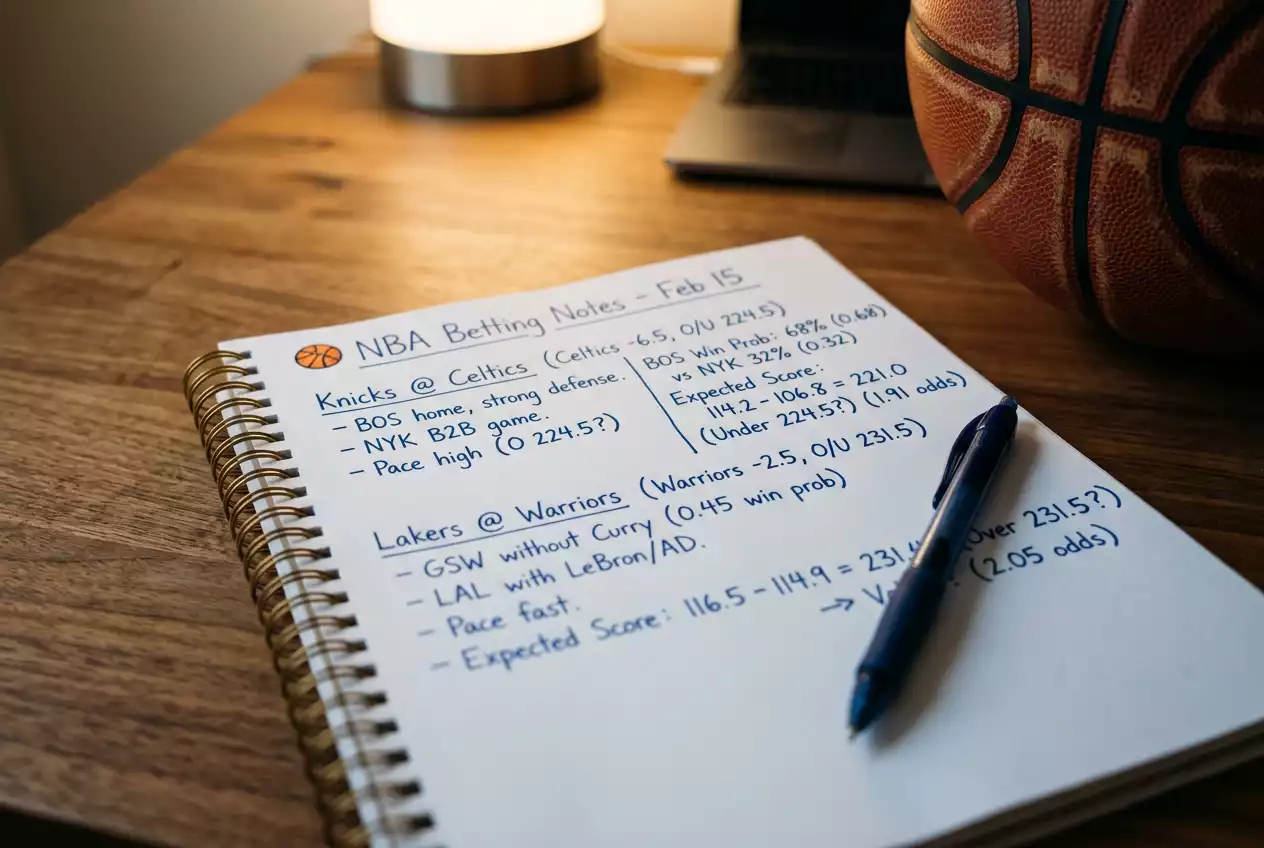
Pace decides how many possessions a game produces. Offensive and defensive ratings decide what each team does with them. Feed both teams in, and the model returns a projected score, a projected total and a projected spread — then holds them up against the numbers your bookmaker has posted.
| Market | Model | Fair odds | At your price |
|---|
How it works. Game possessions come from the two teams’ paces interacting around the league average, not from a simple average. Each team’s offensive rating is then adjusted for the opponent’s defensive rating relative to the league, converted to points over the projected possessions, and the home court value is split between the two sides so the total stays intact. Totals are treated as normally distributed with a standard deviation near 13.5 points and margins near 11.5, which is what turns a two-point difference of opinion into a meaningful probability edge. More in the guides to advanced NBA stats and spread betting.
Estimates only. Ratings go stale fast, and the model knows nothing about rest, travel or a late scratch. 18+ — please gamble responsibly. Free, confidential support at BeGambleAware.
Point Spread: Levelling the Playing Field
The spread is the NBA's great equaliser. Instead of asking "who wins?", the spread asks "who wins by enough?" or "who stays close enough?" A bookmaker sets a handicap — say, -6.5 for the favourite — and you bet on whether the favourite wins by 7 or more, or the underdog loses by 6 or fewer (or wins outright).
Team A -6.5 @ 1.91
Team B +6.5 @ 1.91
If Team A wins 112-104 (margin of 8), Team A covers -6.5. If Team A wins 110-105 (margin of 5), Team B covers +6.5 despite losing outright.
The standard price on both sides of a spread is 1.91 in decimal (equivalent to -110 American), giving the bookmaker a built-in margin. Spreads move based on betting action, injury news, and sharp money. Learning to read those movements is a skill I cover in depth in my guide to NBA spread betting, including key numbers, ATS trends, and the five most common mistakes I see UK punters make.
Moneyline: Picking the Winner Outright
The moneyline strips everything back: pick the team that wins. No margin, no handicap. The catch is in the pricing. A heavy favourite might be listed at 1.18, meaning a GBP 10 bet returns just GBP 11.80. The underdog might sit at 5.00, returning GBP 50 on the same stake. Over the past five seasons, NBA favourites have won 67.98 per cent of regular-season games outright — home favourites at 68.96 per cent, away favourites at 66.47 per cent.
Team A (favourite) @ 1.25
Team B (underdog) @ 4.20
Team A must simply win. Team B must simply win. The odds reflect the probability gap.
Moneyline betting rewards patience and selectivity. Backing heavy favourites at 1.15 or 1.20 requires an absurd hit rate to profit long-term. Conversely, underdogs win outright 32.02 per cent of the time across five seasons — home underdogs at 33.53 per cent, road underdogs at 31.04 per cent. There are spots where underdog moneylines offer genuine expected value, but finding them requires more than gut feeling.
Totals (Over/Under): Scoring Volume as a Market
Totals betting ignores which team wins and focuses on combined scoring. The bookmaker sets a line — say, 224.5 — and you bet on whether the final combined score lands over or under that number.
Over 224.5 @ 1.91
Under 224.5 @ 1.91
Final score 118-110 (total 228): Over wins. Final score 105-98 (total 203): Under wins.
Totals are where pace and efficiency data become essential. The 2025-26 season has continued the three-point revolution — team pace and shooting efficiency are the two variables that most directly determine whether a game flies past or crawls under the posted total. I've found totals markets to be more data-friendly than spreads for systematic bettors, precisely because the inputs (pace, offensive rating, defensive rating) are more stable and measurable than the factors that determine margin of victory. If you're building an analytical approach, totals are a natural starting point.

Pace — the estimated number of possessions a team uses per 48 minutes. Higher pace generally correlates with higher-scoring games, making it a foundational input for totals analysis.
Strategy Foundations: From Gut Feeling to Edge
I once sat in a pub in Shoreditch watching a group of lads pile into a seven-leg NBA parlay because "the Celtics always cover at home on a Friday." They lost. The next week they tried the same thing with different teams. They lost again. The problem wasn't bad luck — it was that they had no framework at all. Just vibes dressed up as strategy.
An actual betting edge comes from systematically identifying spots where your assessment of probability diverges from the bookmaker's implied probability — and being right about that divergence often enough to overcome the margin. That's it. Everything else is decoration.
Adam Silver, the NBA Commissioner, put it bluntly on The Pat McAfee Show in October 2025: manipulating something that seems small and inconsequential to the overall score is far too easy. He stressed that nothing matters more than the integrity of the competition. That statement wasn't just about scandal prevention — it was an acknowledgement that betting markets have become so intertwined with the sport that the league's core product depends on the lines being trustworthy.
So what does a real framework look like? It starts with asking better questions. Instead of "who's going to win tonight?", a systematic bettor asks: what is the true probability of this outcome, and does the decimal price on offer exceed the fair value implied by that probability? That reframe changes everything about how you approach a bet slip.
Research by Wang et al., published in 2024, analysed 2,295 NBA games across a decade and found that 19 per cent of contests remained within 10 points heading into the fourth quarter. That's roughly one in five games where the outcome is genuinely uncertain with 12 minutes left. For live bettors, that's a statistical anchor. For pre-game bettors, it's a reminder that NBA games are far more volatile than spreads suggest — and that fourth-quarter variance is not a bug but a structural feature of the sport.
Fatigue compounds that variance. Garcia et al. measured physical performance decline between the first and fourth quarters of NBA games and recorded an effect size of -1.27 — a massive drop in athletic output. Back-to-back scheduling, travel distance, altitude changes — these aren't soft narratives. They're measurable inputs that bookmakers price imperfectly, especially in secondary markets.
Do
- Anchor every bet in a probability estimate before checking the price
- Track your bets with closing line value as the benchmark — did you beat the closing number?
- Specialise in one or two markets rather than spreading thin across every available line
- Factor schedule context — back-to-backs, travel, rest days — into every assessment
Don't
- Chase losses by increasing stake size after a losing night
- Rely on team-level win-loss records without understanding margin, pace, and efficiency context
- Treat ATS streaks as predictive — small samples in basketball are dangerously noisy
- Ignore the bookmaker's margin: a 1.91/1.91 spread market carries roughly 4.5 per cent overround
The foundation I've built over nine years rests on three pillars. First, advanced metrics — Net Rating, effective field goal percentage, pace, and modern player-impact models like EPM and DARCO. These tell you what's actually happening on the court, stripped of narrative. Second, schedule and fatigue analysis, which gives you an informational edge in spots where the public underweights rest and travel. Third, bankroll discipline — the mathematical scaffolding that keeps you solvent through inevitable losing stretches.
None of these pillars works in isolation. A sharp stat-driven read on a totals line is worthless if you stake 10 per cent of your bankroll on it and the variance catches you. A perfect fatigue angle is wasted if you can't read the decimal odds well enough to know whether the price reflects the edge. Strategy is the integration of all three — and the willingness to pass on a night's slate entirely when the edges aren't there.

Betting on the NBA from the UK: What Changes
A few months into my NBA betting career, I realised I was consuming content that assumed I could walk into a DraftKings retail location, watch games at 7pm local time, and read American odds without a calculator. None of that applied to me. The core analytical principles of NBA betting are universal, but the operational reality shifts dramatically when you're wagering from the UK. Odds format, regulatory framework, bookmaker selection, and scheduling all require adaptation.
The numbers I quoted earlier — millions of monthly bets, a double-digit share of the adult population active online — all flow through an infrastructure built around football, horse racing, and cricket. NBA coverage varies wildly between operators, and the punter who doesn't account for these differences leaves edge on the table.
All UK bookmakers offering NBA markets must hold a licence from the UK Gambling Commission. This isn't optional — it's a legal requirement under the Gambling Act 2005. A UKGC licence means the operator is subject to affordability checks, responsible gambling obligations, and dispute resolution through an approved ADR provider. Always verify a bookmaker's licence status before depositing.
The most significant regulatory development for UK punters in 2026 is the Remote Gaming Duty increase from 21 to 40 per cent, effective 1 April 2026. General Betting Duty for remote bets rises to 25 per cent from April 2027. The Treasury expects these changes to generate GBP 810 million in 2026/27, rising to GBP 1.16 billion by 2030/31. Industry analysts have described the shift as a dramatic restructuring of operators' cost bases that has already changed financial planning across the sector. What does that mean for you? Operators will absorb some of the cost, but margins will tighten. Expect slightly wider overrounds on less liquid markets — and NBA, compared to the Premier League, is a less liquid market on UK books.
Reading Decimal Odds and Converting Formats
If you've ever stared at a line listed as -110 on an American site and wondered what it means in real money, you're not alone. UK platforms default to decimal odds, which are the clearest format for calculating returns: multiply your stake by the decimal number. A GBP 20 bet at 1.91 returns GBP 38.20 (GBP 18.20 profit).
Converting American to Decimal
Negative American odds (e.g., -110): Decimal = (100 / 110) + 1 = 1.909
Positive American odds (e.g., +250): Decimal = (250 / 100) + 1 = 3.50
Calculating implied probability from decimal: 1 / 1.91 = 0.5236, or 52.36%
The gap between implied probability and your estimated true probability is where value lives.
Most American NBA content quotes lines in the -110/+250 format. Being fluent in conversion means you can consume US analysis and instantly assess whether the corresponding decimal price on your UK platform represents value. I keep a conversion shortcut pinned to my phone's home screen — it saves more time than you'd think over an 82-game season.
Which UK-Licensed Bookmakers Cover the NBA Well
Not every UKGC-licensed operator treats the NBA with the same depth. Some offer a full suite — spread, moneyline, totals, player props, quarter lines, same-game parlays, and live markets. Others list a bare-bones moneyline and total with no props at all. The gap matters enormously if your strategy depends on props or first-half lines.
| Feature | What to look for | Why it matters |
|---|---|---|
| Market depth | Spread, ML, totals, player props, quarter lines, SGP | More markets = more opportunities to find mispriced lines |
| Live betting speed | Low latency, rapid re-pricing, cash-out availability | NBA possessions last 24 seconds; slow platforms cost you entries |
| Odds competitiveness | Compare decimal prices on identical spreads across 3+ books | A 0.05 difference in decimal odds compounds over hundreds of bets |
| UKGC licence status | Active licence, no pending enforcement actions | Deposit protection, ADR access, responsible gambling tools |
Flutter Entertainment — the parent company behind several major UK brands — reported group revenue of $15.91 billion in 2025, up 17 per cent. That scale translates into deeper NBA market offerings and tighter odds on headline markets, though secondary markets like alternate spreads and exotic props can still carry wider margins. I recommend maintaining accounts with at least two or three UK-licensed operators to line-shop effectively, which I'll touch on later.
Time Zone Tactics: Betting NBA Games from GMT
Most NBA regular-season games tip off between 7pm and 10:30pm Eastern Time. That translates to midnight to 3:30am GMT during winter months, or 1am to 4:30am BST in summer. The late scheduling creates a genuine strategic wrinkle that most US-focused content ignores entirely.
Sunday afternoon NBA games (starting around 1pm or 3:30pm ET) translate to 6pm or 8:30pm GMT — the most accessible tip-off times for UK punters. Weekend slates deserve disproportionate attention in your weekly betting calendar.
Here's the upside: NBA injury reports, lineup confirmations, and late scratches often drop between 5pm and 6:30pm ET — that's 10pm to 11:30pm GMT. UK punters who are still awake and monitoring news have a window to react before lines fully adjust, especially on platforms with slower re-pricing engines. The downside is obvious: fatigue-driven decision-making at 2am is a bankroll killer. I've learned the hard way to set pre-game limits before midnight and never, under any circumstances, chase a loss during a late West Coast game. If your discipline weakens past midnight, place your bets during UK afternoon hours on the lines available and walk away.

Player Props and Live Betting: Where the NBA Edge Lives
If someone asked me where the sharpest edges in NBA betting have been hiding over the past three seasons, I'd point to two markets: player props and live betting. Both are growing faster than traditional sides and totals. Both are priced with wider margins by bookmakers. And both reward the kind of granular, data-driven analysis that casual bettors rarely bother with.
Live betting share
62.35% of online betting revenue in 2025, growing at 13.62% CAGR through 2031
NBA Q4 stream
$1.99 fourth-quarter streaming product targeted at in-game bettors
Props growth driver
Player performance markets are the fastest-expanding segment in NBA wagering
Player props — bets on individual stat lines like points, rebounds, assists, or three-pointers made — are where bookmaker pricing lags most. The reason is structural: setting accurate lines on 400+ active players across nightly slates, accounting for matchups, minutes projections, pace, and usage rates, is harder than pricing a team-level spread. That complexity is your opportunity. Usage rate (the percentage of team possessions a player uses while on court) and pace (how many possessions a game produces) are the two variables I've found most predictive in prop modelling. When a high-usage player faces a fast-paced opponent, the over on his scoring prop deserves a serious look. When a low-minutes bench player gets pushed into a starting role due to injury, the props are often set based on his season averages rather than the elevated role — that's a pricing gap. I break down the full analytical approach in my player props strategy guide.
Live betting — or in-play, as UK platforms typically label it — represents a different kind of edge. In-play wagers accounted for 62.35 per cent of online betting revenue in 2025, with a projected growth rate of 13.62 per cent annually through 2031. The NBA has leaned into this aggressively, offering a $1.99 fourth-quarter streaming product designed specifically for in-game bettors. Charles Baker, the NCAA President, captured the speed of transformation when he noted in 2025 that nobody was thinking about how fast the whole thing would end up in the palm of your hand back when the regulatory landscape shifted in 2018.
The fourth quarter is where live betting edges concentrate. Nearly one in five NBA games remain within 10 points at the start of Q4, and physical performance deteriorates sharply as the game wears on. Fatigued teams in tight games create systematically mispriced live lines — especially on late-slate West Coast contests where UK bookmaker traders may be less attentive.
The challenge for UK punters is access and speed. Not all UK platforms offer the same depth of live NBA markets, and latency differences between operators can mean the difference between catching a mispriced line and watching it evaporate. I discuss platform selection, cash-out strategy, and emotional discipline for live markets in detail in my NBA live betting strategy piece. The short version: live betting is where the money is moving, but it demands faster decision-making and stricter staking rules than pre-game wagering. It is not a market for the undisciplined.

Bankroll Discipline: The Overlooked Edge
Every NBA betting conversation I've had with a losing punter eventually arrives at the same confession: "I know I should manage my bankroll better, but..." The sentence never ends well. The uncomfortable truth is that most NBA bettors who operate at a loss would break even or better if they simply staked correctly. The picks aren't always the problem. The staking almost always is.
I've seen three staking frameworks survive extended NBA seasons without blowing up. Flat staking — risking the same fixed amount on every bet, typically 1 to 3 per cent of your total bankroll — is the simplest and most forgiving. A GBP 1,000 bankroll with a 2 per cent flat stake means GBP 20 per bet, every bet, regardless of confidence level. It sounds boring because it is boring. It also works.
Flat staking in practice
Bankroll: GBP 1,000. Flat stake: 2% = GBP 20 per bet.
A 10-bet losing streak costs GBP 200 (20% of bankroll) — survivable.
The same losing streak at 5% stakes (GBP 50/bet) costs GBP 500 — half your bankroll gone, requiring a 100% return on the remainder just to break even.
At 10% stakes (GBP 100/bet): GBP 1,000 gone. Account zeroed in 10 bets.
Percentage-of-bankroll staking adjusts the nominal stake as your bankroll rises or falls — always risking the same proportion. The Kelly Criterion takes it further, calculating optimal stake size based on your perceived edge and the decimal odds offered. Full Kelly is mathematically optimal but practically dangerous; most professional bettors use quarter-Kelly or half-Kelly to buffer against overestimating their edge. I walk through all three models with worked NBA examples in my bankroll management guide.
The NBA regular season spans 82 games per team across roughly six months, with 13 to 15 games on a typical nightly slate. That volume means variance has more room to express itself — and more opportunities to recover from downswings — than in any other major sport. Conservative unit sizing (1-2% per bet) is not timidity. It's mathematically appropriate for a sport where single-game outcomes are noisy and the edge, when it exists, is thin.
UK-specific bankroll considerations add another layer. UKGC-licensed operators are required to offer deposit limits, cooling-off periods, and self-exclusion tools. These aren't just regulatory boxes — they're genuinely useful bankroll management mechanisms. Setting a monthly deposit limit that matches your bankroll plan removes the temptation to reload after a bad week. I set mine at the start of each NBA season and revisit it only at the All-Star break. The discipline feels restrictive at first. After a few seasons, it feels like the only sane approach.
Integrity, Regulation and Responsible Gambling
In October 2025, I watched the NBA betting world absorb a series of integrity shocks that should have been a wake-up call for every punter, sharp or recreational. Player investigations, federal indictments, Congressional hearings — the 2025 integrity cases made it impossible to ignore the reality that the markets you're betting into can be compromised, and that the regulatory response is still catching up to the scale of the problem.
Dan Spillane, the NBA's Executive Vice President for League Governance and Policy, told the CFTC in April 2026 that protecting the integrity of games and preserving public confidence in the league and the sport is the NBA's highest priority. That language wasn't casual — it came in a formal letter addressing concerns about prediction markets and their overlap with sports betting. Around the same time, US Senators Ted Cruz and Maria Cantwell wrote to Adam Silver calling the integrity of NBA games a matter of Congressional concern, one that must be trustworthy and free from the influence of organised crime or gambling-related activity.
The 2025 cases centred on prop market manipulation — the exact market segment growing fastest and priced with the widest margins. For UK punters betting player props through UKGC-licensed operators, the practical implication is this: when a prop line looks too good to be true, consider whether the pricing reflects genuine inefficiency or information you don't have. Healthy scepticism about outlier lines is itself a form of risk management.
US Representative Paul Tonko laid out the regulatory stakes with characteristic directness, arguing that the exclusively state-based regulatory approach is fundamentally flawed and will continue to jeopardise both the integrity of sports and public health. The SAFE Bet Act and related federal proposals remain under discussion, but the direction is clear: more regulation, not less, is coming to sports betting markets worldwide. UK punters are already operating under one of the strictest regulatory regimes in the world through the UKGC, but the integrity risks don't stop at national borders when the markets you're betting on originate in a country still building its regulatory infrastructure.
2.7 per cent of UK adults surveyed scored at problem gambling levels on the Problem Gambling Severity Index in the most recent UK Gambling Commission data. 48 per cent of adults had participated in some form of gambling in the preceding four weeks. These numbers are a reminder that the line between recreational and harmful gambling is thinner than most punters believe.
Responsible gambling is not a disclaimer to put at the bottom of a page — it's a structural requirement of sustainable betting. Joyce Lian, writing in the Cornell Journal of Law and Public Policy in January 2026, noted that gambling can be addictive, and that increased access to online sports betting has produced direct financial harms including lower credit scores and higher bankruptcy rates, effects felt most acutely by young men in lower-income areas. That demographic overlaps significantly with the NBA's core audience.
I take this seriously. Every strategy in this guide assumes a punter who is betting with money they can afford to lose, who has set deposit limits, and who understands the difference between a calculated risk and a compulsive one. If you're chasing losses, increasing stakes to recover, or betting money earmarked for rent or bills, the smartest move isn't a better prop model — it's GAMSTOP self-exclusion or a conversation with someone who can help. The National Gambling Helpline is free, confidential, and available 24 hours. No betting edge is worth your wellbeing.
Building Your NBA Betting Framework
If you've read this far, you already know more about the structural realities of NBA betting from the UK than the vast majority of punters placing bets tonight. But knowledge without application is just trivia. The question is: what do you do with it?
My recommendation is to build sequentially, not simultaneously. Don't try to master spreads, props, live betting, and bankroll models in your first week. Pick one market — I'd suggest totals, because the data inputs are clearest and the learning curve is gentlest — and spend a month tracking your assessments against outcomes without risking real money. When you're consistently identifying value at a rate that would be profitable after margin, then commit real stakes at conservative unit sizes.
Spreads and Key Numbers
How point spreads work, why certain margins cluster, and which ATS trends survive across full seasons.
Player Props
Usage rate, pace adjustments, minutes projections, and staking rules specific to individual performance markets.
Live Betting
Fourth-quarter fatigue research, momentum patterns, platform comparison, and cash-out decision frameworks.
Each of those guides goes deeper than this overview can. Together with the bankroll management framework and the advanced stats primer, they form a complete system — not a collection of tips, but an integrated approach to NBA wagering from the UK.
The NBA betting landscape in 2026 is bigger, faster, and more data-rich than at any point in the sport's history. The punters who treat it as a skill pursuit — methodical, disciplined, and grounded in evidence — are the ones who survive contact with real markets. The rest are subsidising the bookmakers' margins. Choose which group you belong to.
Frequently Asked Questions
How does NBA point spread betting work?
A point spread assigns a handicap to the favourite and a corresponding advantage to the underdog. If a team is listed at -6.5, they must win by 7 or more points for a spread bet on them to pay out. The underdog at +6.5 covers if they lose by 6 or fewer — or win outright. Standard spread pricing on UK platforms is typically 1.91 decimal on both sides, which gives the bookmaker an overround of roughly 4.5 per cent. The spread exists to create a roughly even-money proposition on both sides, making it the most popular NBA market for analytical bettors who believe they can assess margin of victory more accurately than the posted line.
What are the best NBA betting strategies for beginners?
Start with totals (over/under) rather than spreads or moneylines. Totals rely on measurable inputs — pace and efficiency — that are easier to research and model than factors driving margin of victory. Stick to flat staking at 1-2 per cent of your bankroll per bet. Track every wager in a spreadsheet, noting your pre-bet probability estimate alongside the decimal odds and outcome. After 50+ bets, review whether your probability estimates are calibrated. Avoid parlays and same-game parlays until you have a profitable record on single bets — they carry the highest bookmaker margins and amplify variance rather than edge.
What is the difference between moneyline and spread betting in the NBA?
Moneyline betting requires picking the outright winner with no handicap. The price reflects each team's perceived probability of winning — a heavy favourite might be 1.18, a big underdog 5.50. Spread betting adds a point handicap that aims to equalise both sides to near-even odds (typically 1.91). The key strategic difference: moneyline bets reward conviction about who wins but can carry expensive prices on favourites, while spread bets reward precision about how much a team wins by. Over the past five seasons, NBA favourites have won 67.98 per cent of regular-season games outright but cover the spread less consistently, making the two markets require different analytical approaches.
How do I read NBA odds in decimal format?
Decimal odds show the total return per unit staked, including the original stake. At 1.91, a GBP 10 bet returns GBP 19.10 (GBP 9.10 profit). At 3.50, the same bet returns GBP 35.00 (GBP 25.00 profit). To calculate implied probability, divide 1 by the decimal odds: 1 / 1.91 = 52.36 per cent. To convert from American odds: for negative odds (e.g., -110), the formula is (100 / absolute value) + 1 = 1.909; for positive odds (e.g., +250), the formula is (odds / 100) + 1 = 3.50. UK platforms display decimal by default, and I strongly recommend leaving that setting untouched — decimal is the most intuitive format for calculating returns and comparing value across bookmakers.
Is live betting on NBA games profitable?
It can be, but the conditions are demanding. Live betting accounted for 62.35 per cent of online betting revenue in 2025, which means bookmakers are heavily invested in pricing these markets correctly. Edge exists in specific situations: fourth-quarter fatigue spots where a team on a back-to-back is fading, momentum swings where the live line overreacts to a scoring run, and slow re-pricing on UK platforms during late West Coast games. The challenge is execution speed and emotional discipline. NBA possessions last 24 seconds, and live odds shift rapidly. If you can't make calm, data-informed decisions under time pressure — especially at 2am GMT — live betting will cost you more than it earns. Pre-set rules for entry, exit, and maximum live-bet allocation per night are non-negotiable.
Created by the ”Betting Tips nba” editorial team.